

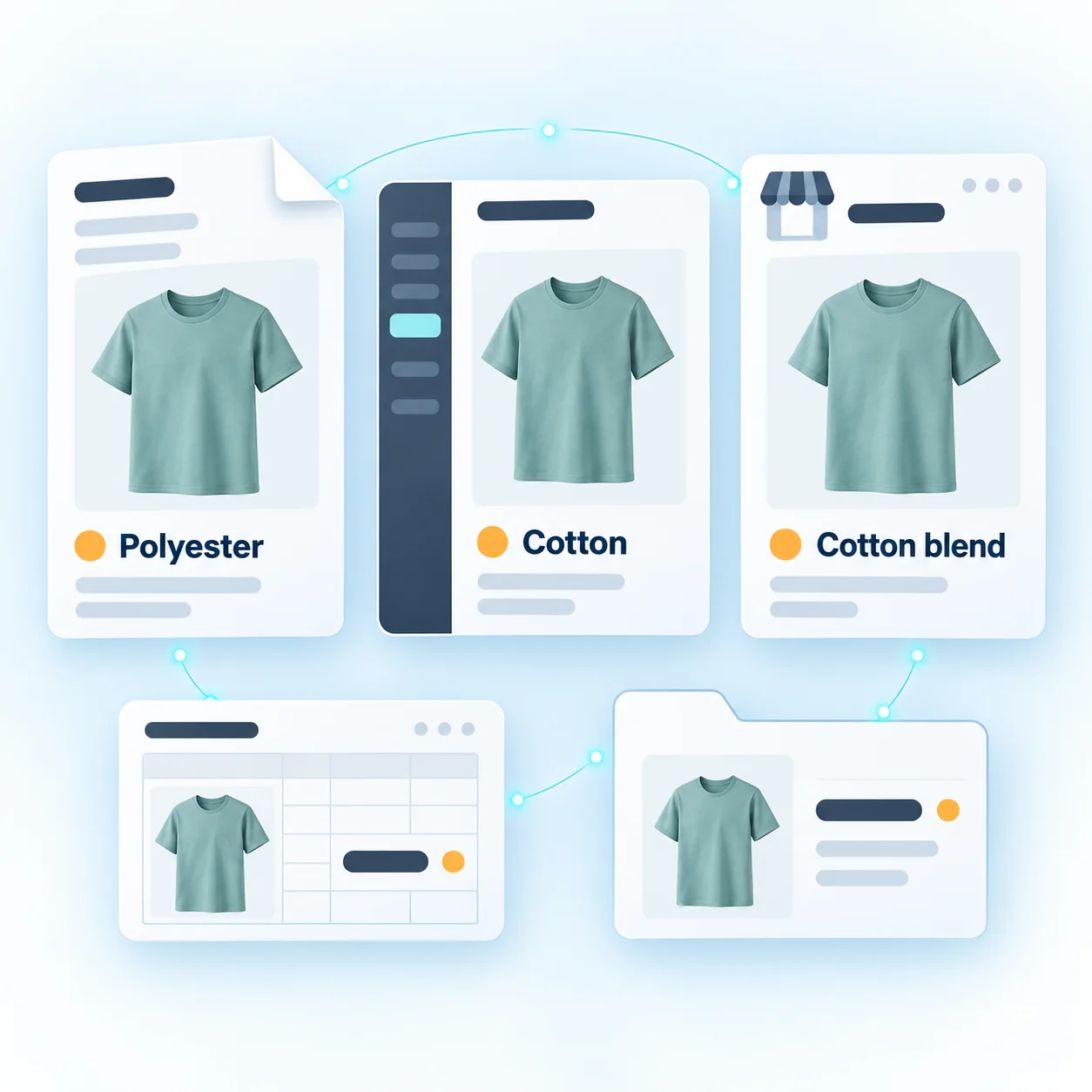
Picture a T-shirt. Shopify says it is cotton. Flipkart says cotton blend. The supplier’s PDF, which nobody has opened since March, says polyester. The customer opens the parcel and decides which one was telling the truth. (This is an illustration, not a client story.)
In my experience, the product data management problems I hear about come down to one sentence: you don’t have one catalogue. You have five files that disagree.
In short: it costs you listings that never go live, returns for the wrong image or material, price drift between channels, and the same fix made several times. It is not about catalogue size alone. Nobody has decided which copy wins. Start by choosing the winner for each field on your 20 top sellers.
Where does your product data live?
In my experience, it often lives in five places:
- Supplier PDFs and WhatsApp photos.
- The spreadsheet your team, VA or agency keeps.
- A shared folder of images.
- Your store admin, such as Shopify.
- The seller panel of every marketplace: Amazon, Flipkart, Meesho, eBay.
Each can begin as a copy of the one before it. Each has been edited by someone, on a different day. Nobody running a store calls this a data problem. They call it “the listing got rejected again”.
What do product data management problems cost?
Four things add up: listings that never go live, images that are wrong for the channel, price drift, and the same fix made again and again.
Listings that never go live. Marketplaces can reject or hide a listing with a mandatory field missing. Amazon’s own seller guide says images that break its rules can lead to suppression. The missing field can be sitting in file one or two all along.
Images that are wrong for the channel. A photo can fail the marketplace’s rules at upload, which blocks the sale. Or it passes and shows last season’s pack, which brings back the return marked “not as described”.
Price drift. You change the price on Amazon. Flipkart still has last month’s. Nobody notices until a customer screenshots both.
The same fix, four times. Correct one weight and you do it in the sheet, the store and every panel. It is not only the number of products. It is also the number of channels and how often things change.
And when something goes wrong, nobody can say who changed the title.
A small illustration. This is a hypothetical, not a client story. Say you check your 20 top sellers and find 12 disagreements, counting one product and field problem as one. Assume each takes 10 minutes to correct in each of three of the five places, so that is 12 × 10 × 3 = 360 minutes, or 6 hours. At ₹300 an hour, for example, that is ₹1,800 of staff time for one pass over 20 products. Swap in your own counts, minutes and hourly cost. Count returns and rejected listings separately, because they carry their own costs.
Large brands feel it too. In a GS1 US case study (page 3), Melanie Painter of Nestlé Professional describes distributors warning of fines for missing images, and one threatening to create the images itself and charge Nestlé. These were warnings, not charges paid.
In a 2026 report, GS1 India and Kanvic Consulting estimate that poor product data causes about ₹5,000 crore in lost revenue a year across Indian e-commerce and quick commerce. That is a modelled figure for the whole sector, not a loss any one seller will see.
The pattern is not only Indian. In a 2018 GS1 US white paper (page 4), Target reported that its main data quality measure, issues per item, fell from 2.1 to 0.9 in seven months, which GS1 US describes as a 60% improvement, after it began measuring product data by category and sharing the results with its suppliers. Target also said shoppers bought products with improved data at a higher rate.
How do you fix inconsistent product data this week?
With the sheet you already have, in three steps:
- Pick your 20 top-selling products. Compare title, price, material, weight and main image in all five places. Count the disagreements. That number is your starting point.
- Decide who is allowed to be right. For each field, write down the one place that wins. Everywhere else copies from it, unless a channel truly needs its own version, such as a marketplace title limit or a local price.
- Count last month’s pain. Rejected listings, returns coded “not as described”, and the hours spent correcting the same field in more than one place. If all three are close to zero, you are probably fine and can stop here. If not, start with the disagreements behind rejected listings and returns.
A filled example row:
- Field: Material
- What each place says: Shopify says cotton, Flipkart says cotton blend, the supplier PDF says polyester
- Place that wins: The current spec sheet
- Owner: Catalogue lead
“Place that wins” means the one source everything else copies from. A week after you fix the winners, count the disagreements on the same 20 products again. Success is a lower count.
One limit to keep in mind. This check finds copies that disagree. It cannot find a value that is wrong everywhere, such as a weight copied from the wrong supplier PDF, so check each winning value against an authoritative source, such as the current spec sheet or the physical product.
If you sell 50 products on one channel and edit the sheet yourself, step two is probably all you need. The same gaps can also keep products out of AI shopping results. Our earlier post on how AI shopping tools choose, and skip, products has a ten-product check you can run on the same 20.
If you look at any tool to help, use these four questions to compare any option:
- Can it require certain fields by category before a product is shared?
- Can it keep one record and still let a channel differ on purpose?
- Can it export the file each marketplace asks for, and let you define your own format?
- Can you see who changed a value, and when?
Where we come in
We are building GridPXM, our product information management (PIM) software, to be one record that every team adds to. It holds required attributes by category and checks a product before it is marked ready to publish, so people stop keeping their own copy. That check runs inside GridPXM.
You can share product information by email, or export it from that same record in an export format you design yourself. GridPXM does not push listings to marketplaces for you. You use the exported file in your own store, marketplace or partner workflow.
It will not fix a bad photoshoot or set your prices. And a new tool just becomes a sixth copy if nobody has decided who owns each field, which is why step two is where to start.

The problem looks the same wherever you sell, and so does the fix: one agreed record, with channel differences kept on purpose. You can sign up. You work on your own catalogue, and we help you bring your data in.
Scattering is not the real problem. Not knowing which copy wins is.
Amazon, Flipkart, Meesho, eBay, Shopify, GS1 and Nestlé are trademarks of their respective owners. Gridverse is not affiliated with or endorsed by any of them. Third-party figures are quoted from the linked sources.