
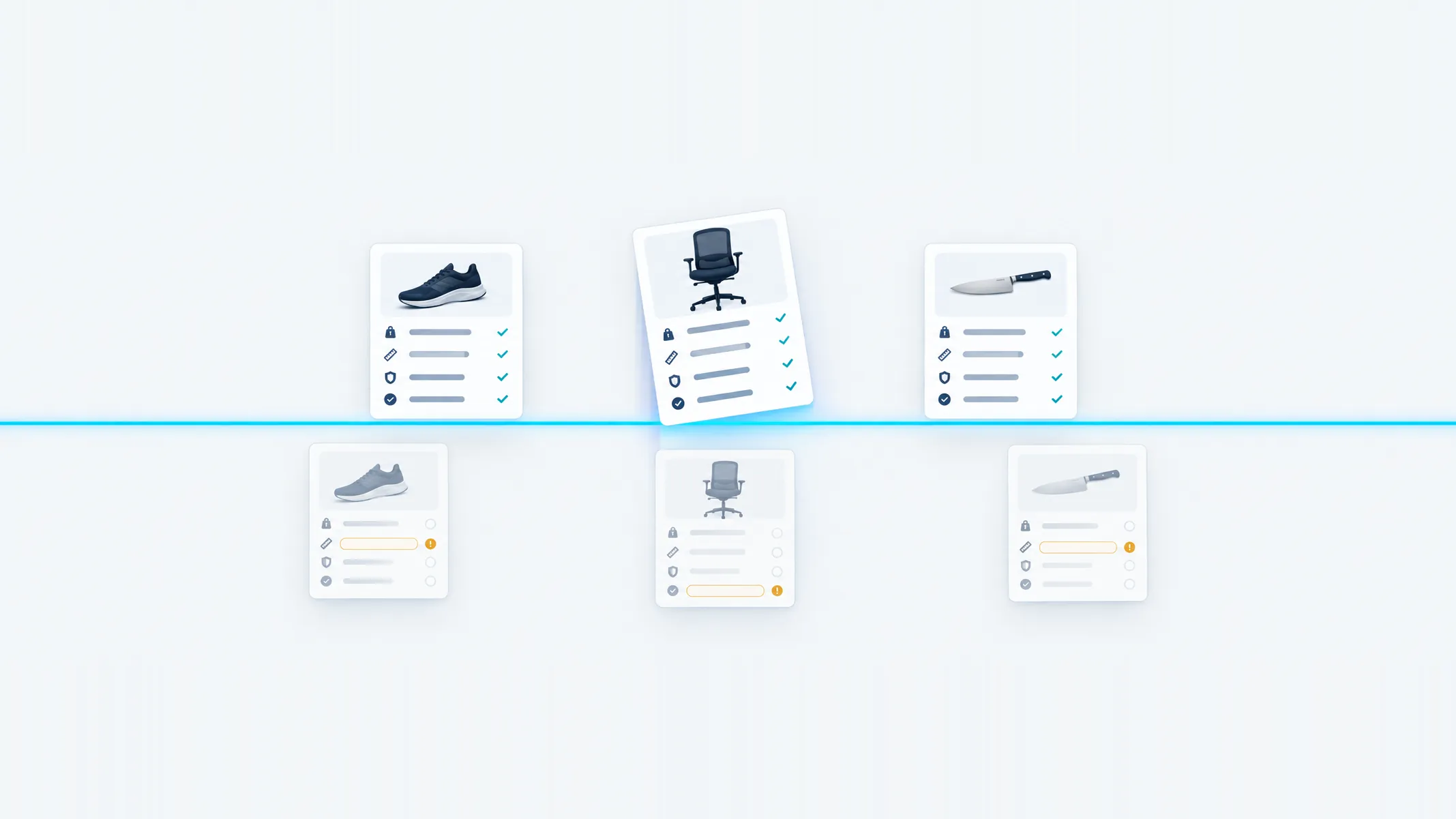
A product does not need a perfect product detail page (PDP) to sell. It needs enough accurate, relevant information for a buyer to understand it, trust it and choose it. Below that threshold, it rarely gets a fair chance. Above it, it can compete.
Call that threshold the PDP Mendoza Line.
What is the Mendoza Line?
The Mendoza Line is a baseball term. It is named after Mario Mendoza, a 1970s Major League shortstop whose batting average hovered around .200. Over time, “.200” became shorthand for the minimum a hitter needs to justify a place in the lineup.
If cricket is more your game, think of a Test batting average of around 30. A specialist batter who averages well below that usually struggles to keep a place in the side, however good they look in the nets. It isn’t an official rule, but every selector knows where that line is.
The ecommerce version is simple: a product page is either good enough to compete, or it isn’t. And crossing the line is not the same as being perfect.
A product doesn’t need perfect content to sell
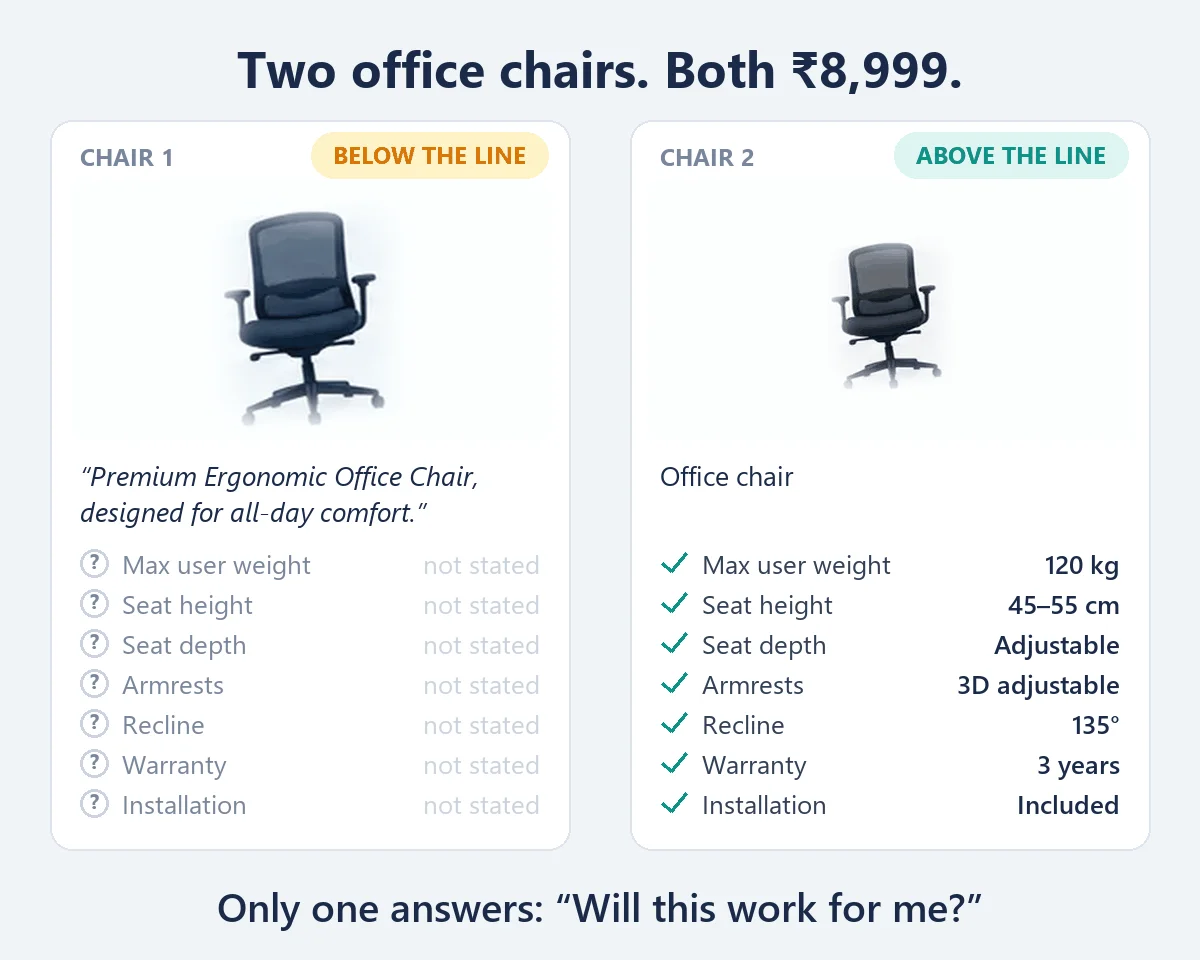
Imagine two office chairs, both priced at ₹8,999.
The first has beautiful photography and a polished line: Premium Ergonomic Office Chair, designed for all-day comfort. But it doesn’t state the maximum supported weight, the seat-height range, whether the seat depth adjusts, armrest adjustment, recline angle, warranty or whether installation is included.
The second has ordinary photos and plainer copy, but clearly states:
- Maximum user weight: 120 kg
- Seat height: 45–55 cm
- Adjustable seat depth
- 3D adjustable armrests
- 135° recline
- 3-year warranty
- Installation included
The first chair may well be the better chair. But only the second one lets the buyer answer the question that matters: “Will this work for me?” That makes the second chair the one they are more likely to buy.
The second chair is above the line. The first, for all its polish, is below it.
Completeness is not readiness
Most product data tools report a completeness score: Product completeness: 72%.
It sounds useful. But 72% ready for what? For Amazon or your own website? For an experienced buyer or a first-timer? For India or the US?
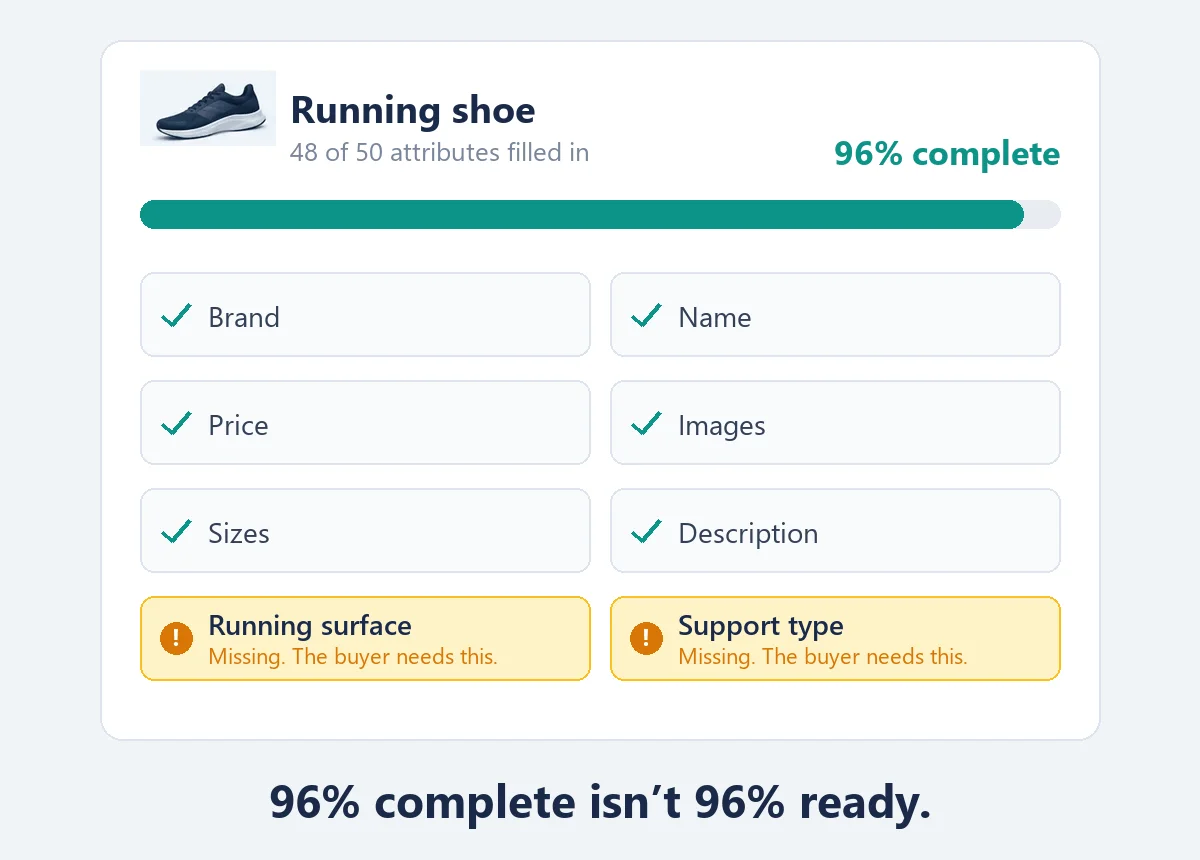
Suppose a running shoe has 48 of 50 attributes filled in. That’s 96% complete. But the two missing attributes are running surface and support type. For someone choosing a running shoe, those two matter more than the other 48 combined.
96% complete doesn’t mean 96% ready. A completeness score treats every attribute as equal. Buyers don’t.
The line moves with the buying context
Take the same running shoe. It has a brand, name, price, images, sizes and a description. On paper, it looks complete.
Then a shopper asks: “I’m a beginner looking for a daily road-running shoe under ₹2,500.”
Now the shopper needs to know whether it is built for road running, whether it suits beginners, what support and cushioning it offers, its heel-to-toe drop, its weight and how it fits.
The product hasn’t changed. The context has. And so the line has moved.
The line also moves by market. A football in India is a soccer ball in the US. A product sold in the US, the EU and Japan may need different certifications, names, descriptions and images for each, not just different words.
The better question for product teams is not “Is our product data complete?” but “Is this product sufficiently described for the context in which we want it to compete?”
Four levels of product readiness
One way to see the line is as four thresholds, each building on the last.
1. Discoverability: can the product be found?
Product name, brand, category, identifiers, search terms and the attributes that filters and search depend on. If a product can’t be found, nothing else matters.
2. Understanding: can the buyer tell what it is?
Images, description, key features, specifications, dimensions, materials and variants. The buyer should be able to form a clear picture of the product.
3. Decision: can the buyer compare and choose it?
Intended use, compatibility, performance, fit, capacity, certifications, what’s included and limitations. This is where most products fall below the line. They are understandable, but not decidable.
4. Trust: can the buyer believe it?
Accurate specifications, authentic images, warranty, certifications and clear policies, and above all, consistency. If your website says a shoe weighs 260 g, Amazon says 280 g and your distributor’s sheet leaves weight out entirely, the buyer has three versions of the truth and no reason to believe any of them.
The line is different for every category
There is no universal line. A T-shirt doesn’t need what an industrial pump needs, and a ₹500 accessory doesn’t need what a ₹50,000 camera needs.
| Category | What usually decides the sale |
|---|---|
| Running shoe | Use → support → cushioning → fit → weight → surface |
| Power tool | Voltage → power → compatibility → dimensions → included accessories → warranty |
| Skincare | Skin type → ingredients → usage → benefits → warnings → size |
| Kitchen knife | Intended use → blade steel → blade length → handle → care → warranty |
So the question is not “How complete is this product?” It is “What information does this category and buying context require?”
Why products stay below the line
When a product page is missing key details, it’s tempting to assume nobody has the information.
At GridPXM, we usually see something else: the information exists, but it’s in another team’s file. The production team knows the steel grade and heat-treatment temperature. The warehouse knows the shipping weight. Compliance holds the certificates. The listing team, the people writing the Amazon page, often never sees any of it.
Each team adds its slice of the product at a different stage, from pre-production to production to listing to packing. No single team sees the whole product. So the product page goes live below the line, even though the business already knew everything it needed.
That changes the fix. Often it isn’t “write more content”. It’s “get what we already know into one place.”
AI shopping raises the stakes
For years, the product page was written for a person who could browse images, scan specifications and use their own judgement.
AI shopping assistants add another reader. Ask one for “a lightweight road-running shoe for a beginner under ₹2,500”, and it has to establish, from the information available, which products actually meet those requirements: what each product is, who it’s for, where it’s used and what it weighs.
A person can make a reasonable guess from a good photo. An assistant needs the information stated. When it can’t confirm that a product fits the request, that product is less likely to be recommended, and the shopper may never see it.
Product information is no longer just content published after a product is made. It is the evidence that lets a product take part in the buying decision.
Fix the long tail first
Most brands don’t manage five products. They manage hundreds, often thousands, once you count every size, colour and pack.
The top 50 get the best photography, the richest descriptions and the most reviews. The long tail stays partly described. The products that already get attention keep improving, while the ones that only need to cross the line stay below it.
A threshold-first approach asks a different question: how many of our products are below the line, and why?
Here is an illustrative example. In a catalogue of 5,000 products, 1,840 might be below the line:
- 450 missing category-specific attributes
- 420 missing critical specifications
- 310 with too few images
- 280 missing compatibility information
- 210 missing dimensions
- 170 with conflicting claims across channels
Now catalogue work has a commercial goal: move products from below the line to ready to compete. Then optimise further.
Where GridPXM fits today
GridPXM doesn’t score products against individual buying contexts yet. It does give you the foundation the line stands on:
- A line for each category. Each product classification defines its required attributes, so a running shoe and a power tool are held to different standards.
- A check before go-live. A product can’t be marked active until it passes validation.
- One record for every team. Production, listing and warehousing add their part to the same product, instead of keeping it in separate spreadsheets.
The Mendoza Line is not the finish line
Crossing the line doesn’t mean a product has an excellent page. It means the product has reached the minimum it needs to compete.
There is plenty of room above it, from minimum viable to good, strong, excellent and best-in-class. The mistake is spending everything on moving a handful of products from excellent to exceptional while thousands stay below the line.
The next time someone says “This product is 85% complete,” ask: “Complete enough for what?” For which buyer, category, channel and market?
Then ask the question that matters most: which of our products are still below the line, and what information would move them above it?
That is where product information stops being a content system and starts being a selling system.