I’m not an investor. I’m a founder. While building my startup, I’ve met some great people, including many investors. One pattern kept coming up in those conversations: many investors asked every startup for the same proof, usually numbers, whatever kind of startup it was. But startups aren’t all the same. I find it useful to think of them as three types, and each one needs to be judged differently.
The three types of startups
Type 1: The visionaries. They are building something that has never existed before, anywhere, not just new to one country.
Type 2: The improvers. They take something that already exists, find its gaps and make it better. Sometimes they improve the product itself. Sometimes they find a better way to make it, deliver it or use it. Uber didn’t invent taxis, and OYO didn’t invent budget hotels. They changed how people find and book them.
Type 3: The distributors. They don’t invent or improve the product. They are better at reaching people: they market it better, sell it better and get it to customers others can’t reach.
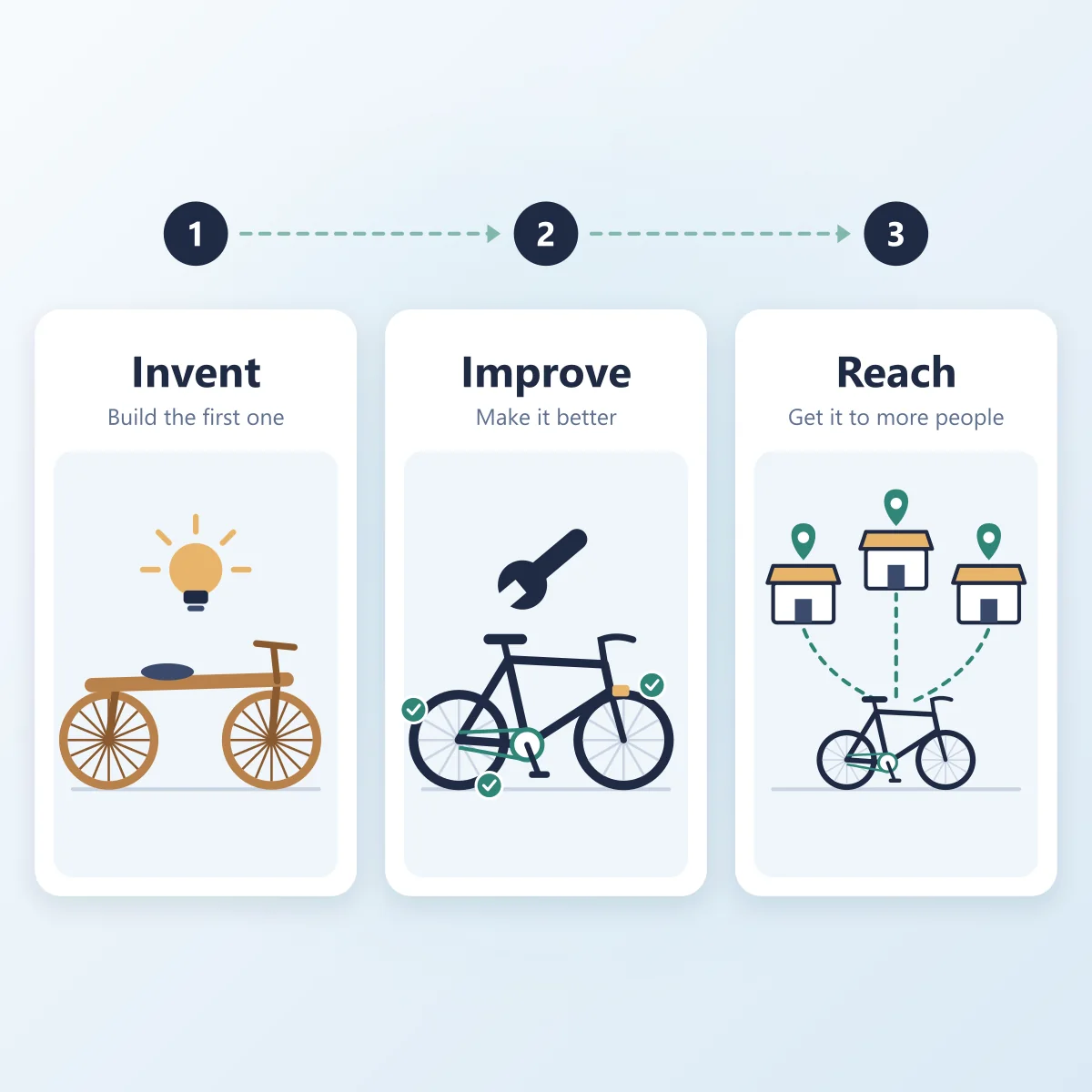
To make this concrete, imagine a world with no bicycles and no two-wheelers of any kind.
- The Type 1 founder is the person who builds the first bicycle.
- The Type 2 founder takes that bicycle and adds brakes, better pedals or a more comfortable seat.
- The Type 3 founder sells the same bicycle, but opens more shops, markets it better and reaches towns nobody else reaches.
Every startup needs to execute, whatever its type. The difference is where each one’s main advantage lies: inventing, improving or reaching people. Many startups do a bit of all three. What matters is which one is their main advantage, because that is what investors will judge.
True Type 1 startups are rare. Even most companies that feel visionary, including many in AI, are building on something that existed before. That’s fine. A startup doesn’t always need an original idea. It needs a clear advantage, and evidence that customers value it.
Three risks every startup carries
The journey is also a different length for each one. It depends on three risks:
- Market risk: Does anyone want this, and will they pay for it?
- Product risk (also called technology risk): Can it be built, and will it work?
- Execution risk: Can this team deliver, sell and grow it?
Every startup carries all three risks. What differs is how much is already proven when it starts. Type 1 starts with almost nothing proven. Type 2 starts with a proven market, but not that customers will switch to something better. Type 3 starts with a proven product and market, but not that its way of reaching people will work and pay. The less that is proven at the start, the longer it takes to show real proof, and the harder it is to raise money.
A founder with a famous track record, or strong backing, or an idea in a market investors are excited about, can raise money whatever their type. Most founders don’t have any of these, and the rest of this post is for them.
The first version is never the final one
Our bicycle founder explains the idea to investors, and the first question is: “How can anyone balance on two wheels?” The second is: “Bring us market validation.” But how do you validate a market for something nobody has ever seen?
Most Type 1 founders don’t have an answer at first. So they do what they can: they build it themselves, with their own money or a grant if they can get one.
The first version is almost always imperfect, and that’s normal. The real history of the bicycle shows it. The first two-wheeler, built in Germany in 1817, was made of wood and had no pedals. You sat on it and pushed yourself along with your feet. The bicycle we know today, with pedals, a chain and two equal-sized wheels, only arrived in the late 1880s.
It took around 70 years and many different people to turn the first bicycle into one everyone could ride. Most of that progress was Type 2 work. But none of it would have happened without that first wooden machine.
Startups don’t stay the same type forever. Today’s Type 1 company becomes a Type 2 company the day it starts fixing its own first version, and it faces Type 3 competitors the day someone copies it. That’s when everything changes: the founder has to shift gears and build distribution and scale fast, or years of hard work, sweat and struggle can be overtaken by someone who simply sells better.
So the first version is only the start. Founders don’t need it to be perfect, because they’ll keep improving it. Investors shouldn’t judge it as the final product, because it won’t be.
The hardest moment comes after the first version and before the market believes in it: a valley between prototype and product. The savings or grant money is used up, demand still isn’t proven, and the few offers that come often take away most of the founder’s control. Unless a rare investor backs something that doesn’t exist yet, or someone close to you trusts you with spare money, this is where many visionary startups stop. It’s where the survival game I wrote about in The Three Games is won or lost. I believe this is where Startup India, other Government of India initiatives and CSR funding should put extra focus.
The mistake: pitching the machine instead of the need
I learned this point the hard way, and I’m still working on it.
The bicycle founder pitches the machine, so investors ask about balance. The need already existed, though: walking is slow and horses are expensive. Investors can do the maths on a known problem even when the solution is new.
Imagine the pitch started differently:
“Most people in this town walk an hour each way to work. A horse costs more than a year’s wages, and feeding it costs more every month. Most families will never own one.”
Now the investor has something to work with. The question changes from “Will this work?” to “If this works, how big could it be?” Investors know how to answer the second question.
The balance doubt doesn’t disappear. But it shrinks from a reason to say no into one specific risk the founder can prove, perhaps with nothing more than a video of someone riding down the street.
Your solution can be new, but the problem almost never is.
Here’s what this looks like in my own work. Take India, where we started. Indians ordered about ₹64,000 crore (about US$7.5 billion) worth of goods through quick commerce in FY25, roughly double the year before. Customers are getting used to delivery in minutes. But only a handful of companies can offer it, and even one- or two-day delivery is out of reach for most sellers. Building that capability is expensive: Zepto alone reported a loss of about ₹3,367 crore (roughly US$400 million) in FY25. India has more than 7 crore (70 million) registered small businesses, and almost none of them can spend like that, whether it’s a small brand, a growing e-commerce company, or a woman selling to her network on WhatsApp or through social commerce. Even most large brands don’t own this capability. They reach fast-delivery customers through a few platforms, on those platforms’ terms.
The same gap exists in many countries: fast delivery belongs to a few giants, while most of the world’s small businesses can’t afford to build it. As customers get used to fast delivery, the gap between the few who can offer it and everyone else keeps growing. That’s the need. Giving every seller the capability only a few have today is what we’re building toward at Gridverse as we scale.
The real dividing line: is the need proven?
What makes fundraising hardest usually isn’t novelty. It’s unproven demand. Investors are really asking two questions: is the need proven, and is the solution proven?
A need is proven when people already spend money or time on the problem. A solution is proven when the product already exists and works. Put those together and there are four situations:
- Need proven, solution proven: easiest to fund. Investors can do the maths. Most Type 2 and 3 startups are here, though for Type 3 investors judge the founder’s reach more than the idea, because the idea can be copied.
- Need proven, solution new: hard, but fundable. A Type 1 startup that shows the need in numbers: “walking is slow, horses are expensive.”
- Need not proven, solution new: hardest to fund. A Type 1 startup that pitches only the product, with no proof anyone needs it.
- Need not proven, solution proven: rare. A working product nobody needs has little to fund.
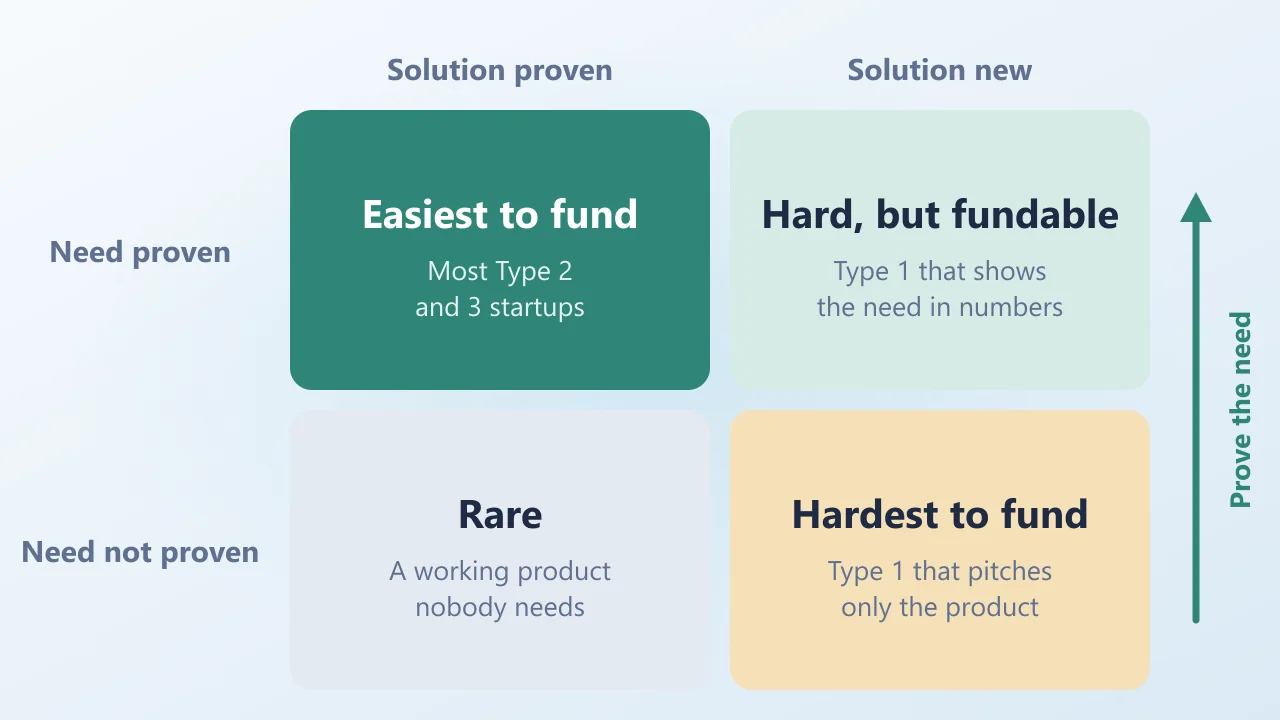
A Type 1 founder can’t prove the solution overnight. But they can often prove the need, and that can move them from “hardest to fund” to “hard, but fundable.”
What I’m learning along the way
I’m still in the middle of my own race, so these aren’t rules. Be honest about which type your startup is, because improving or distributing something is a strength, not a smaller story. Lead with the need, then prove the one big doubt with real evidence. And start raising well before your savings run out, because that is when a founder’s position is weakest.
The world needs all three
Without Type 1, there would be no bicycle. Without Type 2, it would have no brakes, no chain and no tyres. Without Type 3, most people would never have ridden one.
Every startup has to convince someone. Type 1 has to do it before there is anything to show. Founders can make that easier by showing the need in numbers. Investors can remember that some of the best opportunities are the ones they can’t calculate yet.
Which type is your startup, and what can you prove today?
A personal note: at Gridverse, we’re in the middle of our own race, and we’re currently speaking with investors who share a long-term view. If that’s you, I’d be glad to talk. Get in touch.