
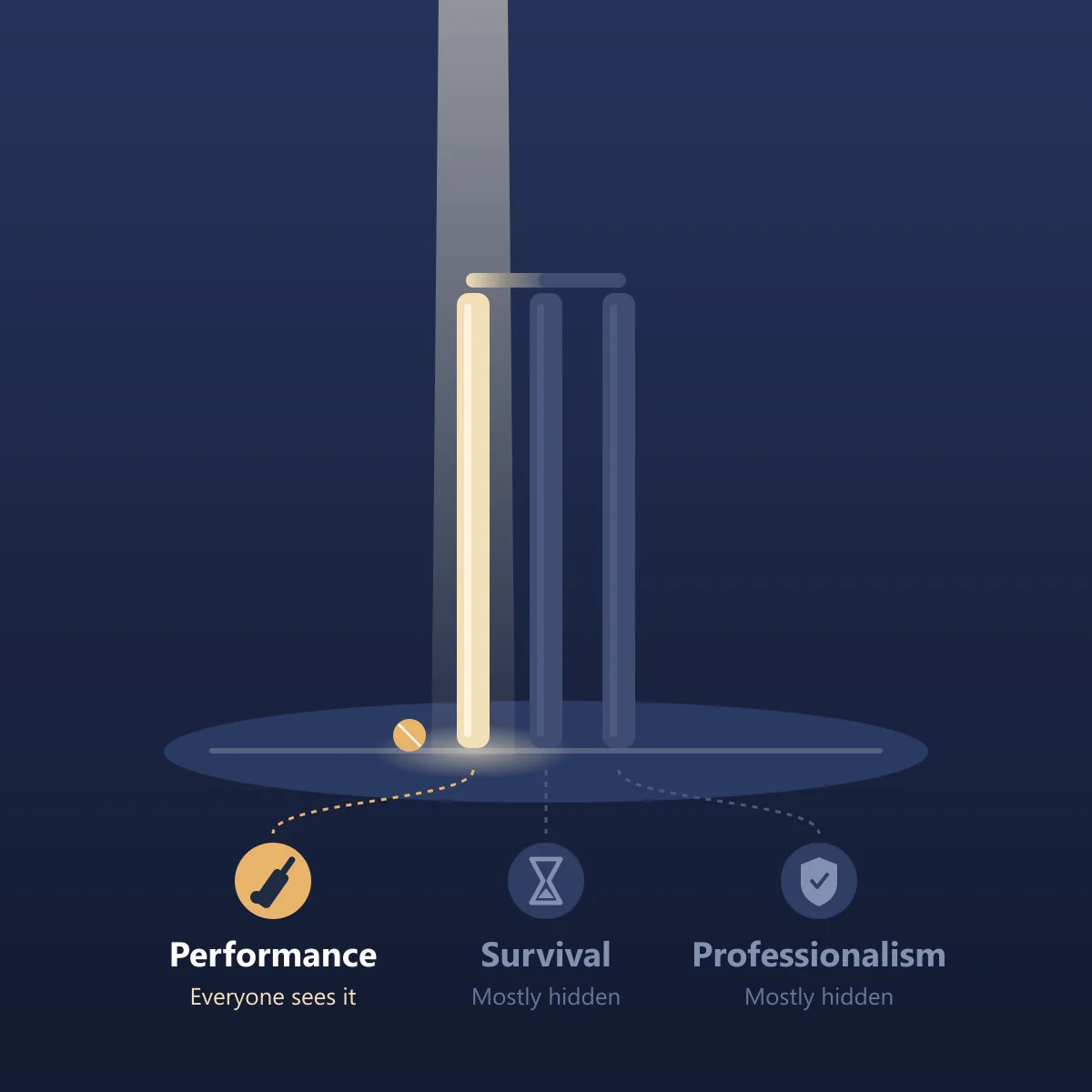
Every young cricketer thinks they’re playing one game: Cricket.
Every entrepreneur thinks they’re playing one game: Business.
Both are wrong.
Success in any performance field—whether sports or business—depends on winning three simultaneous games, most of which are invisible.
Most people lose the games they never realized they were playing.
Game 1: The Performance Game (What Everyone Sees)
In cricket, this is straightforward:
- Batting technique
- Bowling skills
- Fitness and fielding
- Match performance
In business:
- Product quality
- Marketing
- Sales
- Operations
- Execution
- Customer experience
- Unit economics: whether sales actually make money
This is the visible game. What fans, customers, and spectators judge. Where most people spend most of their energy.
But here’s the truth: Most careers don’t collapse because of a lack of skill. Most careers collapse because of the other two games.
Game 2: The Survival & Opportunity Game (What Actually Determines Your Future)
This game is invisible but decisive.
In cricket, success depends on your life infrastructure, not just your game:
- Can your family support 5–10 years of “no income”?
- Can you afford professional coaching, diet, fitness, and travel for trials?
- Do you have contacts to get visibility with selectors and academies?
- Are you in the right geography? Mumbai opens doors that remote districts rarely will.
- How many failures can you absorb before life forces you to quit?
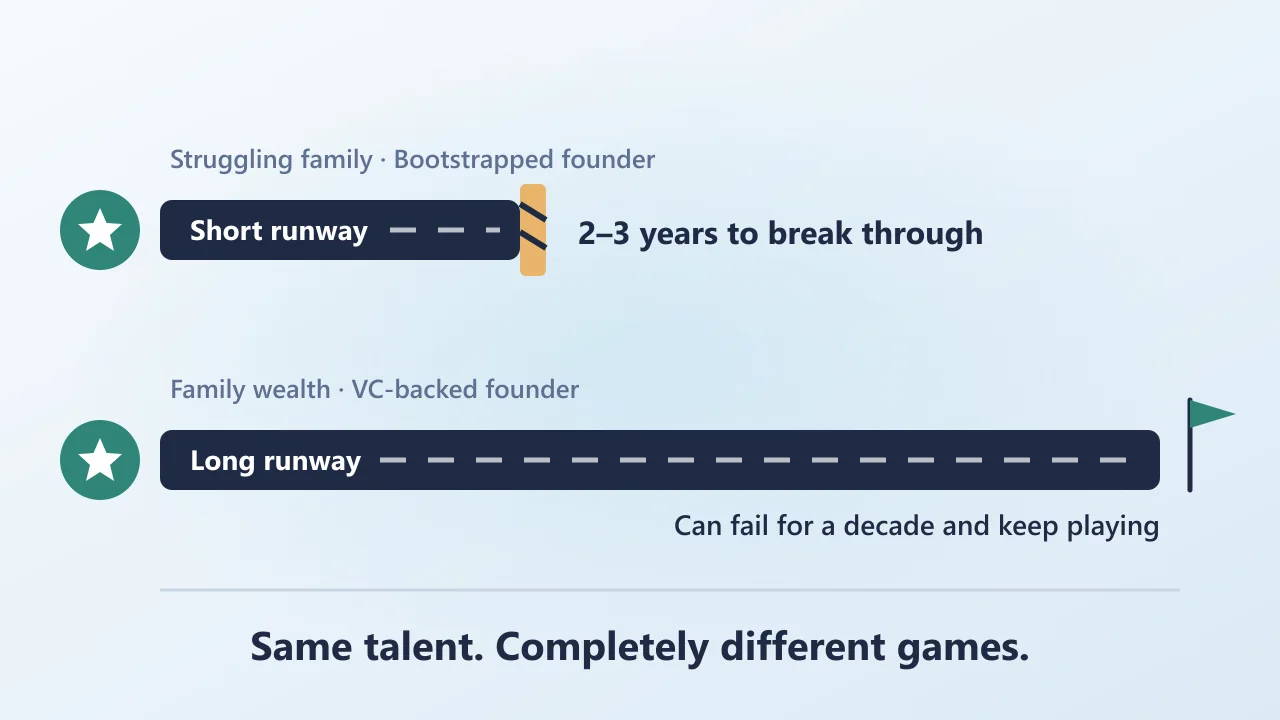
This isn’t about privilege or pity. It’s about the runway.
A talented player from a struggling family has maybe 2–3 years to break through before financial reality forces a different path. A player with family wealth can fail for a decade and keep playing. Same talent. Completely different games.
The player without resources must be strategic about everything: which trials to attend, when to relocate, whether to take coaching jobs to stay in the ecosystem, and when to accept that the window is closing.
The player with resources can experiment, recover from setbacks, and wait for the right opportunity.
Neither approach is better. But playing a resource-heavy strategy when you have a limited runway will end you.
Your starting point decides your strategy. A player from a wealthy, connected family can take risks, fail multiple times and experiment. A middle-class player must be methodical, timing trials carefully and balancing cricket with part-time work to extend the runway. A player from a poor family is in survival mode from day one: every trial might be the last chance.
The biggest mistake is playing a privileged strategy without privileged resources. In cricket terms, it’s playing like Virender Sehwag, aggressive and boundary-seeking, when your life situation calls for Rahul Dravid’s patient, methodical approach.
You can’t play T20-level aggression when your life requires Test-match patience.
Startups work identically.
Many startups fail even when the idea and the product are good. They fail because founders:
- Ran out of personal savings before reaching profitability
- Hit family pressure to get a “real job”
- Couldn’t sustain the mental toll of uncertainty
- Lacked the network to open critical doors—investors, early customers, advisors
- Couldn’t afford to iterate long enough to find product-market fit
A bootstrapped founder must reach revenue in months. A VC-backed founder can burn cash for years building toward a bigger outcome. Same business fundamentals. Completely different survival games.
The bootstrapped founder saying “we’ll figure out monetization later” is playing someone else’s game. The VC-backed founder obsessing over immediate profitability might be missing the billion-dollar opportunity.
Talent is irrelevant if you can’t survive long enough to use it.
Game 3: The Professionalism Game (The One Nobody Talks About)
But even if you have talent (Game 1) and resources (Game 2), there’s a third silent killer: your own behavior.
This is the game of discipline, consistency, humility, emotional maturity, coachability, work ethic, reliability—and how you handle both success and failure.
Every coach has seen this player: exceptionally talented, opportunities handed to them, family support in place, and visibility with selectors—everything aligned for success.
But they showed up late to practice. Argued with coaches. Let early success inflate their ego. Developed a reputation for being difficult. Burned bridges with teammates who would later become selectors. Made poor lifestyle choices that eroded their fitness.
They were brilliant at Game 1. Advantage in Game 2. But they destroyed themselves in Game 3.
Here’s what they didn’t understand: Cricket is a relationship-dependent game. Selectors don’t just pick the best batter—they pick reliable, coachable, team-oriented players they trust. When two players have similar talent, the one with a professional reputation usually gets the call.
This isn’t about being fake or political. It’s about recognizing that your behavior either compounds your opportunities or destroys them.
Talent opens doors. Character keeps them open.
Business is identical.
Brilliant founders with strong ideas fail because of:
- Impulsive decisions that alienate investors
- Co-founder fights that tear companies apart
- Lack of discipline in execution
- Arrogance after early wins that blinds them to market feedback
- Poor communication that drives away top talent
- Emotional burnout from the inability to manage stress
- Treating employees poorly, then wondering why they can’t retain anyone
Many investors put it simply: they don’t fund ideas, they fund founders.
A CEO with a great product but a reputation for burning through teams will struggle to raise capital. A founder who ignores board advice will find their next round much harder. A leader who can’t control their temper will watch their best people leave.
Game 3 failures are particularly painful because they’re entirely self-inflicted. The external barriers—talent, resources, opportunities—were already cleared. The only obstacle left was the person themselves.
Meta-Awareness: The Skill That Separates Those Who Make It from Those Who Don’t
The best athletes and founders constantly ask themselves:
- “What is my real bottleneck?”
- “What is the game I’m actually losing?”
- “Is my geography, network, or environment holding me back?”
- “Am I exceptional at this, or just good?”
This is pattern recognition applied to your own life.
A cricket example:
“My batting has improved steadily for two years, but opportunities haven’t increased. My real bottleneck isn’t skill—it’s visibility. Selectors in my state don’t know I exist. I need to move to a different city or find a coach with selection committee connections.”
A business example:
“Our product is genuinely solid and users love it, but sales remain flat. The bottleneck isn’t features—it’s distribution. We need to stop building and start figuring out how to reach customers.”
A professionalism example:
“Our team keeps churning. Exit interviews are vague but consistent. Maybe the bottleneck isn’t compensation or workload—it’s my leadership style. I need feedback I’m not getting.”
This meta-awareness—the ability to diagnose which game you’re losing—is more valuable than raw talent.
Because once you see the real bottleneck, you can address it. Without that awareness, you keep grinding at the wrong problem while the real one kills you slowly.
Why This Matters for Businesses, CEOs, and Investors
If you’re hiring, investing, building teams or mentoring, the Three Games change how you judge people. You stop asking “Is this person talented?” and start asking:
- Do they have a runway? Can they survive long enough to succeed?
- Are they playing the right strategy for their resources, or copying someone else’s playbook?
- Are they self-aware? Can they see their own bottleneck and ask for help?
- How do they handle pressure and setbacks?
- What’s their reputation with former colleagues and advisors?
The founder with a brilliant pitch but a history of co-founder conflicts is a red flag, however innovative the product. The founder who clearly names their bottlenecks and has adapted their strategy, even before the business is scaling, might be the best bet.
The Uncomfortable Truth
Most talented people fail not because they weren’t good enough, but because they mastered performance while ignoring survival and professionalism. By the time they see what’s actually holding them back, it’s often too late.
The games don’t get easier when you see them clearly. But at least you’re finally playing the right ones.
Which game are you losing right now? Not the one you’re focused on, the one you’re ignoring. That’s where your future is actually being decided.
Talent opens the door. Strategy, discipline and survival decide whether you walk through it.